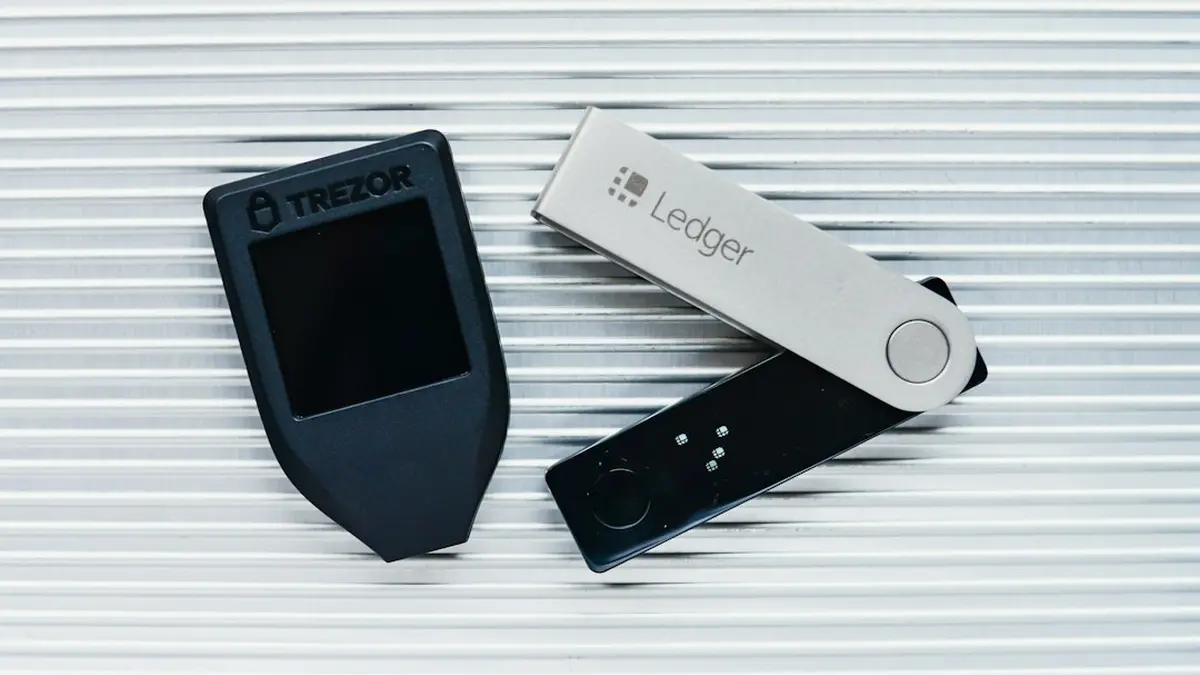
For an EVM farmer, the choice between Ledger and Trezor comes down to whose clear signing you trust at claim time. Ledger's has been around longer and was patched for a serious bug in August 2026. Trezor's is open source but arrived on September 7, 2026, with six launch partners. Neither brand changes whether you're eligible for anything: the snapshot sees your address, not the device behind it. What the device changes is what you can see on its screen when a claim page asks you to sign.
The brief for this piece asked for more than the published record allows. The sources I'm working from don't list which chains each device signs for, which claim portals support which device, which software wallets each pairs with, passphrase support or connection type. So I haven't guessed at any of that. On price, Yellow.com Research lists the Ledger Flex and Trezor Safe 7 at $249 each. If a specific claim matters to you, check that project's own compatibility page before you buy. Everything below comes from the makers' own posts and named reporting, as of September 25, 2026.
The four devices side by side
| As published, to Sept 25, 2026 | Ledger Nano X | Ledger Nano S Plus | Trezor Safe 5 | Trezor Safe 3 |
|---|---|---|---|---|
| ERC-7730 clear signing (maker's own posts) | Generic Parser, introduced 2025 | Generic Parser, introduced 2025 | Supported since Sept 7, 2026 | Supported since Sept 7, 2026 |
| Named in Ledger Security Bulletin 024 (Ethereum app 1.19.0 through 1.22.2) | Yes | Yes | No | No |
| Update needed for current clear signing | Ethereum app 1.22.3 or later (published Aug 25, 2026) | Ethereum app 1.22.3 or later (published Aug 25, 2026) | Firmware update, no other setup (Trezor) | Firmware update, no other setup (Trezor) |
| Where parsing and display happen (Ledger Academy's description) | Inside the Secure Element | Inside the Secure Element | Separate MCU; Secure Element holds keys | Separate MCU; Secure Element holds keys |
| Clear-signing code open source (maker's statement) | Not stated in sources | Not stated in sources | Yes, firmware and decoding logic | Yes, firmware and decoding logic |
| Clear-signing launch partners named by maker | None named in sources | None named in sources | 1inch, Aave, Lido, Tether, LiFi, Hyperliquid | 1inch, Aave, Lido, Tether, LiFi, Hyperliquid |
| Only official desktop app download | ledger.com/ledger-live | ledger.com/ledger-live | trezor.io/trezor-suite | trezor.io/trezor-suite |
| Maker customer-data incidents (Coinpedia, TechCrunch) | 2020 leak; further exposure early 2026 | 2020 leak; further exposure early 2026 | Jan 2024 (~66,000 users); shipping vendor Aug 2026; ~347,000 phishing emails via Brevo Sept 2026 | Jan 2024 (~66,000 users); shipping vendor Aug 2026; ~347,000 phishing emails via Brevo Sept 2026 |
The two rows marked "not stated in sources" say only that the documents I have don't cover them for Ledger. They don't say Ledger lacks either feature. I've kept them in because a farmer choosing between the two needs to know where the record is thin.
Ledger Nano X
Ledger's case for itself is architectural. In its own Ledger vs Trezor comparison, updated April 17, 2026, it says one Secure Element parses the transaction, draws the screen and signs, all inside the same protected chip. It has shipped about 8 million devices, and it introduced its ERC-7730 Generic Parser in 2025, well ahead of Trezor.
The weak point is that parser. Ledger Security Bulletin 024 describes a bug in which an array count was stored in a field too small to hold it, so anything over 255 entries wrapped around. "A list of 257 entries was recorded as 1, and the app reviewed a single entry instead of all of them." In the proof of concept, 256 undisplayed operations executed on a private fork. The Nano X is on the affected list. The fix shipped in Ethereum app 1.22.3 on August 25, 2026. Exploiting the bug needed a compromised host as well as a malicious descriptor, and crypto.news reported no confirmed stolen funds as of August 24.
The Nano X costs $149, per Yellow.com Research. Buy the Nano X if you want Ledger's single-chip design and the more mature ERC-7730 parser, and you'll keep the Ethereum app updated.
- Parsing, display and signing inside one Secure Element, per Ledger
- ERC-7730 parser in place since 2025
- Clear-signing bug fixed and publicly disclosed
- Ethereum app 1.19.0 through 1.22.2 could clear sign one entry while approving 257
- Customer data leaked in 2020, with further exposure in early 2026
Trezor Safe 5
Trezor was late to this. Until Clear Signing arrived on September 7, 2026, its devices showed raw hashes while your computer showed a readable description that malware could fake. Trezor's own blog says that blind-signing gap has "resulted in a lot of funds being lost." It now works on the Safe 5 through Trezor Suite, WalletConnect and Trezor Connect after a firmware update. The whole stack, firmware and decoding logic, is open source. That matters if you'd rather not take a maker's word on what the screen shows.
The limits are age and coverage. The feature is weeks old, and Trezor named six launch partners, with more networks and protocols only planned. The bigger worry in September wasn't the device but the mailing list. TechCrunch reports that around 347,000 phishing emails reached Trezor customers through a breached email provider. The emails linked to a fake app that asked for the wallet backup. That followed a shipping-vendor breach in August.
The Safe 5 costs $169, per Yellow.com Research. Buy the Safe 5 if auditable clear signing matters more to you than a longer track record.
- Clear-signing firmware and decoding logic are open source
- Works through WalletConnect as well as Trezor Suite
- No setup beyond a firmware update
- Clear signing only live since Sept 7, 2026, with six named partners
- Customer data exposed in Jan 2024 and Aug 2026, then a phishing wave in Sept 2026
Ledger Nano S Plus
Everything the published record says about the Nano X applies here too. It's on the same LSB 024 affected list, it takes the same Ethereum app 1.22.3 fix, and it uses the same Secure Element design. Nothing in my sources separates the two at claim time. Buy it if you want Ledger and don't want to pay for the Nano X.
Trezor Safe 3
The Safe 3 is on Trezor's Clear Signing list alongside the Safe 5, with the same partners and the same open-source stack. The only Trezor excluded is the older Model One. Buy it if you want Trezor's clear signing at the lowest Trezor price, $79 per Yellow.com Research.
Where they part ways
The first difference is the one Ledger argues hardest. On Trezor's two-chip design, Ledger Academy writes, "a compromised MCU could theoretically show one transaction while signing another." That's a fair structural point, and I'd take it seriously. But August showed that the harder problem is the software doing the parsing, wherever it runs. Ledger's own parser, running inside its Secure Element, displayed one entry and approved 257. The chip didn't prevent that. A fixed parser did.
The second difference is maturity against transparency. Ledger has had ERC-7730 parsing since 2025 and has already found and fixed a real bug in it. Trezor has had it for under two months, but anyone can read the code. For a farmer signing claims across many EVM protocols, coverage decides whether you see words or hex. My sources don't give Ledger's descriptor coverage, and Trezor's covers six named partners.
The third difference is the one most likely to cost you money, and it isn't the hardware. The biggest loss in these sources, $282 million from a Trezor user in January 2026 per CleanSky, came from a fake support agent talking the victim out of the recovery phrase. Both makers have leaked customer contact data, so both brands' owners are on scammers' lists. Ledger says it never contacts you by text, WhatsApp, Telegram or phone. Trezor says any request for your backup, PIN or passwords "is always a scam." A claim page asking for a signature is a different risk from a checker that only reads your address, and it's worth knowing what a read-only lookup is before you connect either device anywhere.
Which to buy
Buy the cheaper model of whichever brand you choose. Nothing published separates the Nano X from the Nano S Plus, or the Safe 5 from the Safe 3, on what the screen shows when you sign a claim.
If you farm EVM protocols and want the longest-running ERC-7730 parser, get the Ledger Nano S Plus and confirm the Ethereum app is on 1.22.3 or later before your next claim.
If you want to be able to audit what your screen is telling you, or you mostly use Aave, Lido, 1inch, LiFi or Hyperliquid, get the Trezor Safe 3 and update its firmware. Expect phishing aimed at your inbox, because Trezor's customer lists have been in bad hands twice since August.
If your claims are on Solana, Cardano, XRP or another non-EVM chain, none of my sources say which device signs them. Check the claim project's own compatibility page before you spend anything, because that answer matters more than any row above.
Whichever you choose, treat any token you weren't expecting as bait. Trezor's guidance on airdrop scam tokens says to "assume that it is a scam and not interact with it." Ledger's phishing status page names QCORE as one such airdropped token.
Comments
No comments yet. Be the first to comment!
Leave a Comment